
Mount Huangshan
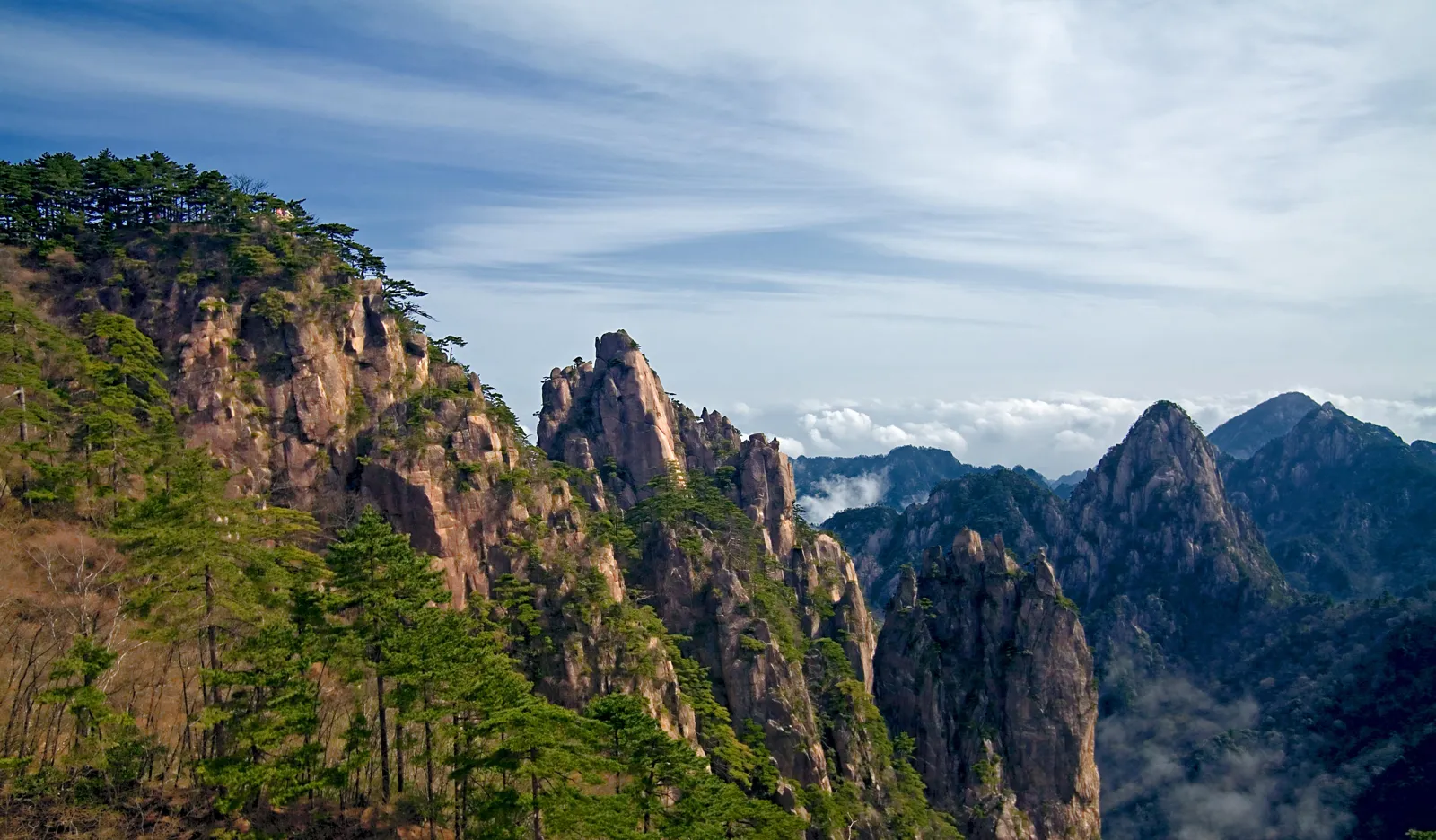
Mount Huangshan is a mountain landscape in southern Anhui, inscribed on the UNESCO World Heritage List in 1990 for both cultural and natural significance. Its granite peaks, distinctive pines and shifting clouds have helped shape Chinese painting and literature as well as attracting walkers and photographers. It is a rewarding choice for first-time visitors who want a mountain experience with time to appreciate the views.
Planning your visit
Season & conditions
We recommend spring or autumn for a first mountain trip: spring brings fresh growth, while autumn offers seasonal colour and appealing walking conditions. Choose dates with some flexibility in your wider itinerary, as the experience changes with the mountain weather. Pack layers, a waterproof outer layer and shoes with a dependable grip.
Try to enjoy the landscape at more than one pace. Stop beside a pine or a rock formation as well as at the broad viewpoints; details often become more striking when distant peaks are partly hidden. Build in breaks and keep enough energy for the steps back to your hotel or cableway.
Time & pace
From Huangshan North railway station, use the tourist coach connection or a private road transfer to the mountain’s southern gateway at Tangkou. Allow roughly an hour for this road journey as a planning estimate, followed by the scenic-area transfer to your chosen cableway. Shanghai has high-speed rail connections to Huangshan; keep arrival and transfer time separate from your mountain sightseeing.
For a comfortable first visit, use a cableway up and down and spend one night in a mountaintop hotel. The Yungu and Yuping cableways offer different approaches, so choose a walking route around your hotel location and stamina. Cableways reduce the long ascent but do not remove the steps between viewpoints.
Allow two days for the mountain itself. On the first day, travel up and explore a manageable group of viewpoints; on the second, take another walk before descending. An overnight stay gives you the option of an early view without a pre-dawn journey from the city. Add Xidi or Hongcun on a separate day rather than after an exhausting descent.
The inscribed place
UNESCO recognises Huangshan as a mixed cultural and natural property. Its dramatic scenery is important in the history of Chinese landscape art, and the mountain also preserves significant natural habitats and plant life. The inscription concerns Mount Huangshan; the historic villages of Xidi and Hongcun form a different World Heritage property.
Before walking, ask your guide to explain how Chinese landscape painters use mountains, empty space and changing viewpoints. Then look at the real landscape: a pine leaning from rock, a ridge appearing through cloud, or the layers of peaks beyond a foreground tree. This gives the scenery a cultural dimension without turning the walk into a lecture.
Choose a route you can enjoy at a steady pace. Tell us about stairs, knee concerns and your usual walking distances when planning, so the day is shaped around your interests rather than the longest possible circuit.
Read the official UNESCO property record ↗
Related destinations
Journeys featuring this site
Before you visit
How many days do I need on Huangshan?
Two days with one night on the mountain is our recommended first visit. Add transfer time and any village sightseeing around those two days.
Can I use cableways both ways?
Yes. Plan an ascent and descent using the operating cableways, with a walking route between them suited to your pace.
Does a cableway visit still involve steps?
Yes. Mountain paths between hotels and viewpoints include steps, so discuss the amount of walking before choosing the route.
Can I visit from Shanghai in one day?
We recommend an overnight mountain visit instead. Combining intercity travel, transfers and the mountain in one day leaves little time to enjoy the landscape.
Use Plan Your Journey to tell us which places you would like to explore and how much time you have.