
The Grand Canal
The Grand Canal is a network of historic waterways and associated sites across eastern and northeastern China, inscribed on the UNESCO World Heritage List in 2014. Its 31 component parts record the engineering and transport system that moved grain, goods and people between regions. It is especially rewarding for travelers interested in everyday waterside life, historic cities and the connections between places.
Planning your visit
Season & conditions
For the Jiangnan cities discussed here, we suggest spring or autumn for comfortable canal-side walking. Spring brings fresh greenery; autumn is a good time to combine a walk with gardens and outdoor meals. In summer, begin early and place a museum or a shaded break in the middle of the day.
Think of this as a series of city chapters, rather than a route to cover in one continuous journey. Choose a place that already fits your trip, then look closely at its bridges, streets and relationship with the water. One well-explained stretch can tell you more than several hurried transfers.
Time & pace
From Shanghai, high-speed trains take around 30 minutes to Suzhou or about one hour to Hangzhou on suitable services, before local transfers. Allow a half-day for a focused canal chapter. Two or three days let you compare two cities and still leave room for meals and other sights.
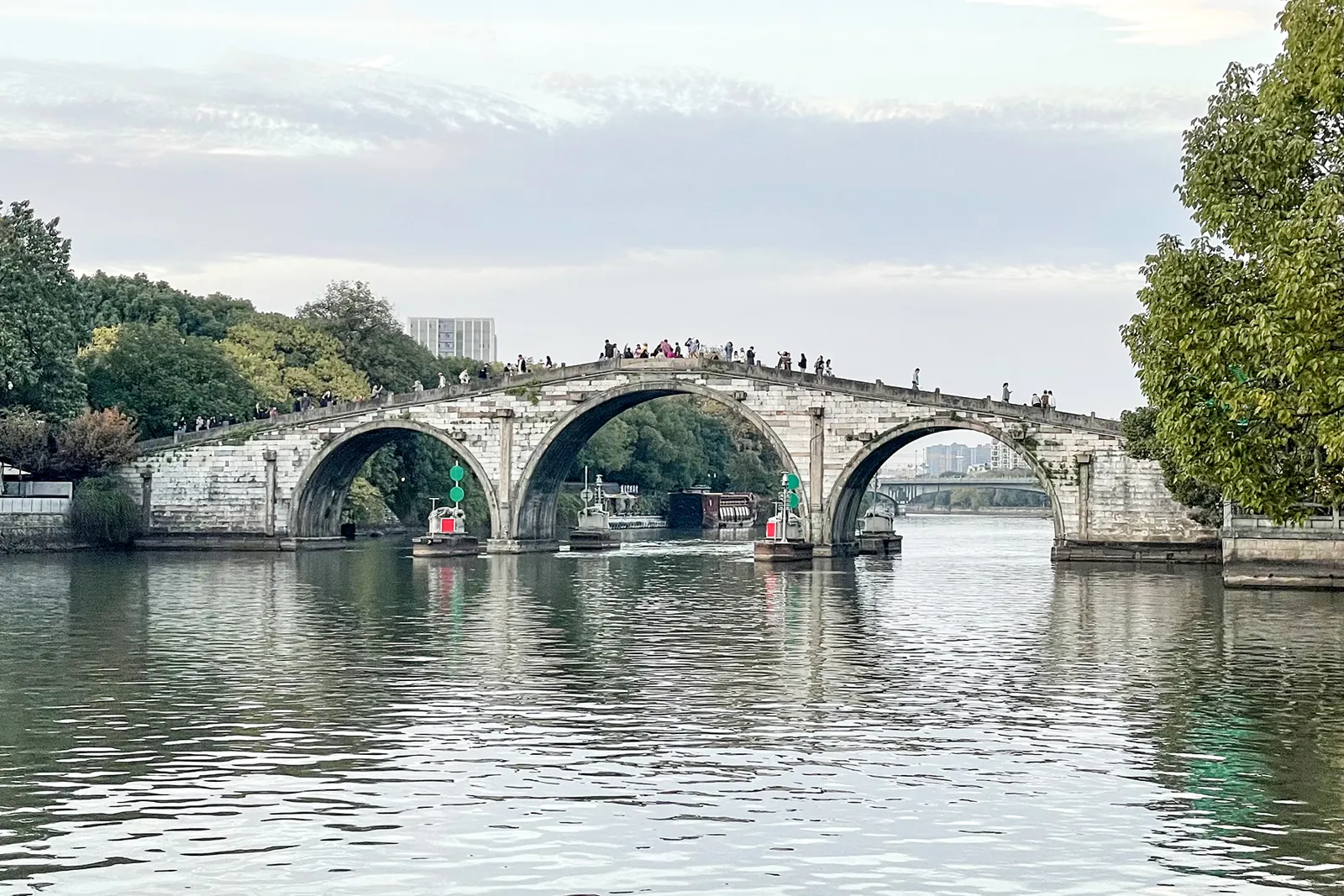
In Suzhou, start with Pingjiang Road’s historic district or the Shantang historic district. Both are identified in the official Suzhou component inventory. In Hangzhou, Gongchen Bridge and the Qiaoxi historic district offer an accessible introduction to the inscribed Hangzhou section. In Yangzhou, Slender West Lake and Ge Garden are named heritage elements connected with the canal’s prosperity.
Nanxun, in Huzhou, is another useful choice: the inscribed Nanxun section includes the historic district and the old Ditang waterway. Give its waterside streets several hours rather than adding it as a brief photo stop between cities. Our existing Suzhou and Nanxun journeys below connect you with these places.
The inscribed place
UNESCO records 31 component parts across eight provincial-level regions. These include sections of the Tongji, Wei, Huitong, Zhong, Huaiyang, Jiangnan and Zhedong canals, alongside associated historic sites. The system developed over centuries; its importance is both technical and social, linking water management with the organisation of a vast territory.
The official component list names the Suzhou Section of Jiangnan Canal and the Nanxun Section of Jiangnan Canal. Local government inventories identify Pingjiang and Shantang within the Suzhou heritage and Nanxun’s historic district within the Nanxun heritage. These specific places provide the basis for the journey links on this website.
As you walk, look for steps down to the water, bridge approaches and buildings facing the canal. Ask what arrived by boat and who lived or traded nearby. The details make it easier to understand why a working transport network became such a powerful influence on urban life.
Read the official UNESCO property record ↗
Related destinations
Journeys featuring this site
Before you visit
Which city is best for a first visit?
Choose Suzhou for historic canal streets, Hangzhou for Gongchen Bridge and Qiaoxi, or Yangzhou for the relationship between canals and gardens. Start with the city that fits your wider route.
How many days do I need?
A half-day introduces one city chapter. Allow two or three days to compare two cities without making the trip mostly about transfers.
Are Pingjiang Road and Nanxun part of the heritage?
Yes. The official component list and local government inventories identify the relevant historic districts within the Suzhou and Nanxun sections.
Can I visit the entire Grand Canal in one day?
No. The inscription spans multiple provinces and cities; select a particular section or a short multi-city route.
Use Plan Your Journey to tell us which places you would like to explore and how much time you have.